How to Choose a Dental Google Ads Agency (And the Questions Most Practices Forget to Ask)

When I inherited a Los Angeles dental account, the previous management had it generating leads at $190 apiece. Same practice, same platform, comparable budget. After the account was restructured, that number fell to $65. The gap between those two figures is what choosing the right Google Ads partner is actually worth: not a marginal difference in polish, but a threefold difference in what every new patient costs you.
That's why how to choose a dental Google Ads agency matters more than almost any other marketing decision a practice makes. The frustrating part is that most practices vet providers on the wrong signals: a glossy portfolio, a confident pitch, a spot on a "top agencies" list. They skip the questions that actually predict results. This guide covers those questions, the red flags that map to each one, and the benchmarks that tell you what competent management really produces. One note of honesty first: I run a dental PPC service myself, so hold this checklist to the standard it deserves. Every question below is one that any good provider should pass. They're the questions we'd want asked of us.

Why the Right Dental PPC Partner Matters More Than the Budget
The right partner matters more than the budget because in dental PPC, management quality compounds, silently, every month. A competitive dental click can cost more than your lunch, and the margin between a profitable account and a wasteful one comes down to daily details: which search terms get excluded, where the budget concentrates, whether the tracking actually captures booked patients.
Bad management doesn't announce itself. The ads run, the clicks arrive, the invoices go out, and the waste accrues quietly in places a monthly summary never shows: irrelevant search terms, out-of-area clicks, budget spread across ad groups that never produce a phone call. A practice can fund that leak for years without knowing, because the reporting is designed around activity rather than outcomes. Vetting your provider carefully isn't diligence for its own sake; it's the single cheapest budget protection available to you. Every dollar you'd spend with the wrong partner is a dollar the right one would have turned into patients.

First, Know What Kind of Help You're Vetting
Before you compare providers, be clear which kind of provider you're comparing, because a full-service agency, an SEO shop, and a paid-search specialist are three different purchases with three different vetting criteria. Whether you're weighing the best SEO agency for dentists or a dedicated paid-search partner, make sure you're asking questions that fit the service.
If you haven't yet settled that question of breadth versus focused depth, we've written a full breakdown of the difference between a full-service agency and a PPC specialist and when each is the right call. From here on, this guide assumes you've decided you want help with Google Ads specifically, and what's left is choosing who.

The Six Questions Most Practices Forget to Ask
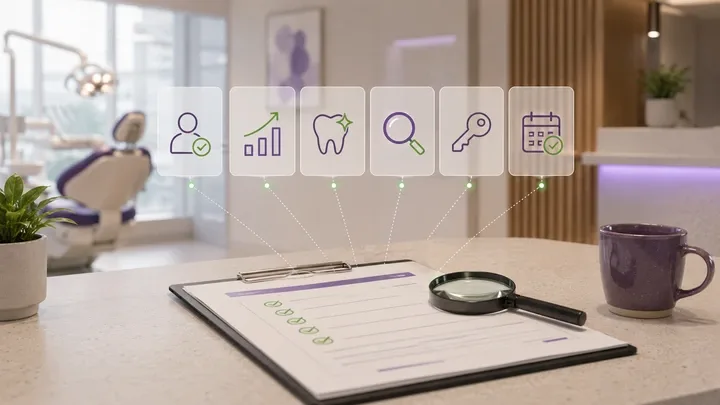
The fastest way to separate a strong PPC agency for dentists from a weak one is to ask six specific questions, because the answers reveal how they'll actually treat your account, not how they sell.
Who will actually manage my account day-to-day? The person pitching you is rarely the person who'll be in your account on a Tuesday afternoon. Ask who that person is, how experienced they are, and how many other accounts they're juggling. A good answer names a real human with real dental accounts behind them. A vague answer like "our team handles it" usually means your campaign becomes one of forty on a junior manager's list, and the daily discipline dental PPC requires quietly disappears.
Do you report on clicks, or on booked patients? This one question exposes more than any other. If a provider's reporting leads with impressions, clicks, and click-through rate, they're measuring activity. What you need measured is enquiries: calls, forms, bookings, and what each cost. Insist on conversion tracking and call tracking as non-negotiables. The difference is not academic. In an emergency dental account in Ormond Beach, Florida, clicks rose just 6% over four months while conversions climbed 23% on the same budget. A clicks-only report would have called that quarter flat. The patient-focused report showed it for what it was: the account's best stretch yet.
Can you show me dental-specific results? Dental PPC has its own terrain: emergency versus planned intent, insurance-related searches, procedure-specific economics, and a minefield of budget-draining search terms. A provider with real dental accounts has already paid for that learning; a generalist will fund their education with your budget. Ask for anonymized before-and-after results from dental clients specifically. Anonymized is the credible format: a provider who protects client confidentiality while showing real numbers is displaying exactly the professionalism you want.
How do you handle search terms and negative keywords? This is the discipline question, and in dental it's the single biggest waste lever. Ask how often they review the search-term report and how they build negative keyword lists. A strong answer describes a weekly routine: exclude the irrelevant queries early, promote the converting ones to tighter match types, repeat. If the answer is vague, or negatives are treated as a one-time setup task, your budget will leak every day on searches that could never become patients.
Do I own my Google Ads account and my data? The question almost nobody asks, and the one with the longest consequences. If the agency owns the account, then the day you leave, your entire campaign history leaves with them: the conversion data, the tested ads, the refined keyword lists your budget paid to build. You start from zero, and they know it, which quietly changes the power balance of the whole relationship. The fair standard is simple: you own the account, the provider works in it, and the engagement is month-to-month. Any provider unwilling to agree to that is telling you something important.
What happens in the first 90 days? A credible provider describes an arc, not magic: an audit of what exists, a restructure around patient intent, then tightening optimization with checkpoints along the way. Be suspicious of both extremes: promises of instant results, and requests for six months of patience before anything is measurable. Meaningful movement inside a quarter is a reasonable bar. In a North Carolina pediatric account, a focused three-month revamp took monthly conversions from 17 to 43 while cutting cost per lead by a quarter. Ask what their 90-day checkpoints are, and how you'll both know whether it's working.

Red Flags That Predict Wasted Budget
Most red flags are just the six questions answered badly, and each one predicts a specific kind of waste. Guaranteed rankings or guaranteed patient numbers top the list: nobody controls the auction or patient behavior, so a guarantee is a sales tactic, not a plan. A proposal with no mention of conversion tracking means the provider intends to measure activity instead of patients: expect click-heavy reports and a quiet phone. Reporting samples that lead with impressions and CTR tell the same story from the other end.
Then come the structural warnings. An agency-owned ad account is the leverage problem from question five wearing a contract. Long lock-in commitments of six or twelve months with penalties protect the provider from accountability, not you from risk; confident providers work month-to-month because their results do the retaining. And a one-size-fits-all campaign structure, pitched identically to every practice, signals a template operation in a niche where the difference between an emergency searcher and an implant researcher is the whole strategy. None of these flags requires you to assume bad faith. They simply tell you where the incentives sit. Your budget deserves incentives that point in the same direction yours do.
How "Top Dental Marketing Agency" Lists Actually Work
Those roundups of the top dental marketing agencies you find when researching deserve a candid explanation: many are paid placements or affiliate-driven, which means inclusion often signals a marketing budget rather than client results. Some lists of top dental marketing companies are assembled from whoever purchased a listing, sponsored the site, or pays the publisher a referral fee for every practice that clicks through. The reviews may be real; the ranking logic usually isn't what it appears.
This doesn't make every list worthless; some directories are genuinely curated. But it changes what lists are for. Use them for discovery: names you hadn't encountered, a sense of the market. Never use them as the decision. The decision is the six questions above, asked directly, answered specifically. A provider who ranks on no list but answers all six well will outperform a heavily-promoted one who dodges question five. Lists measure visibility; your cost per lead is determined by discipline.
What Good Looks Like: Benchmarks From Real Dental Accounts
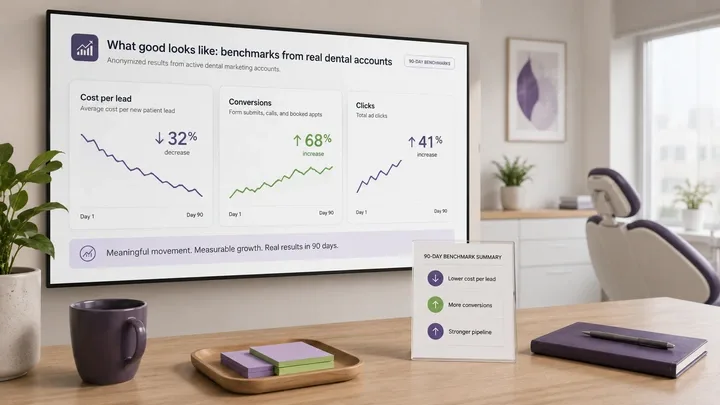
Once you know the questions, it helps to know what competent answers produce, because the best dental marketing campaigns share a recognizable signature in the numbers. Cost per lead falls over time rather than drifting up: in the Los Angeles account mentioned at the top, disciplined restructuring and search-term control took it from $190 to $65 over eight months. Conversions grow faster than clicks (the Ormond Beach pattern) because quality of traffic, not volume, is doing the work. And meaningful improvement shows inside the first quarter, the way the North Carolina revamp did, rather than being perpetually promised for next quarter.
Those three patterns are what disciplined dental PPC management produces: falling cost per lead, conversions outpacing clicks, and visible movement within 90 days. They're the benchmarks to hold any provider against, including us. If you want to understand the mechanics behind them, our guide to what actually drives booked appointments in dental PPC breaks down the strategy layer in detail.
Frequently asked questions
What should I ask a dental PPC agency before hiring them?
Ask six things: who will manage your account day-to-day, whether they report on booked patients or just clicks, whether they can show dental-specific results, how they handle search terms and negative keywords, whether you own your ad account and data, and what their first 90 days look like. The answers to these six questions predict account quality far better than portfolios or pitch decks.
How do I know if my current PPC agency is doing a good job?
Check two trends: your cost per lead should be falling over time, and conversions should be growing faster than clicks. If your reports lead with impressions and click-through rate, if you've never seen a search-term report, or if you can't say what a lead costs you, those are warning signs worth acting on, starting with asking your agency the six questions above.
Should a dental PPC agency guarantee results?
No. A guarantee should lower your confidence, not raise it. No provider controls Google's auction or patient behavior, so guaranteed rankings or patient counts are a sales device rather than a plan. What a credible provider commits to instead is process and transparency: proper tracking, a clear 90-day arc, and measurable checkpoints you can both verify.
Do I need an agency that only works with dentists?
Not strictly. A disciplined generalist can run competent campaigns. But dental-specific experience means the provider already knows the search-term traps, the emergency-versus-planned intent split, and realistic cost-per-lead ranges for your market, so your budget isn't funding their learning curve. That familiarity is a meaningful head start in a niche where Google Ads for dentists rewards exactly this kind of accumulated, specific knowledge.